
What Is SEO? One Trick That Can Change Things Overnight
Are you planning to learn about search engine optimization and wondering where to start? You must have heard that it is super beneficial if you are building your website or running an online business. Even for that matter, having a business or brand and trying to bring it into the online limelight is challenging. Here I am presenting you a complete guide on what is SEO and how it works. Also, you’ll get some insights on how artificial intelligence is impacting the process.
Let’s get started.
What is SEO?
SEO stands for search engine optimization, which means working on your website in a way to rank higher on search engines by optimizing every metric. The process aims to get organic, editorial, and free traffic, or shine best in the natural search results in the search engines.
The higher your website is in organic search, the more people will see it.
3 Major Components of SEO
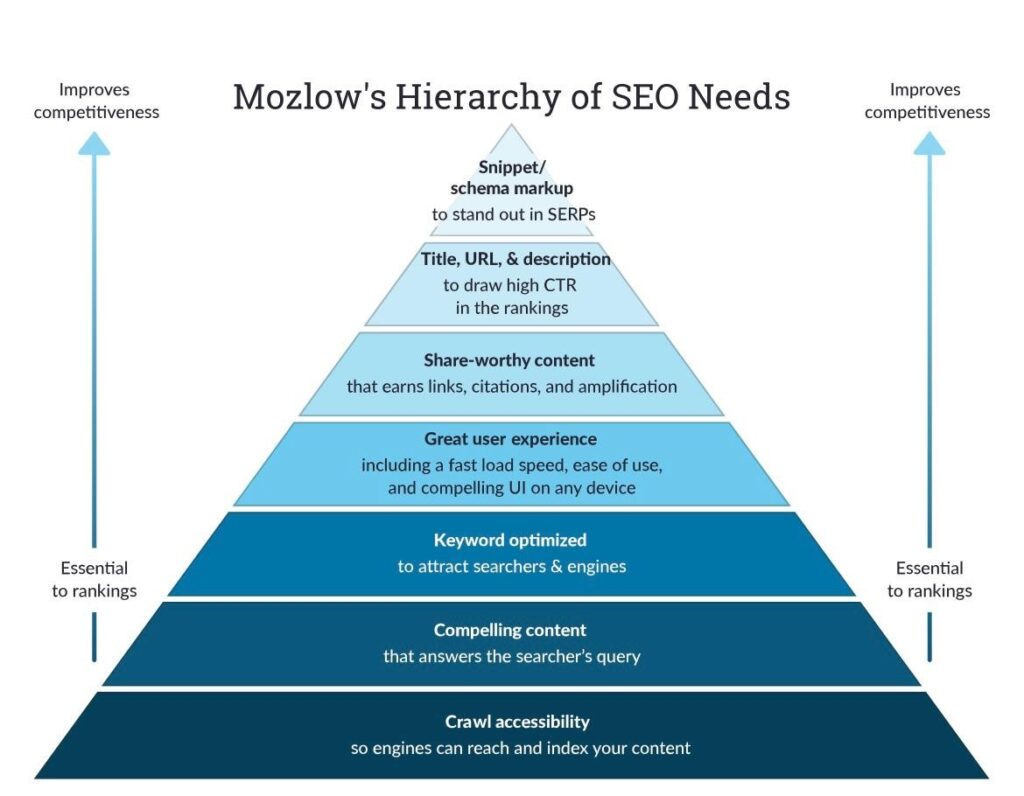
Working with seo requires focusing on various tasks requiring technical skills, creativity, analytics, and more. These tasks come under the following three main elements of SEO:
1. On-Page Optimization
This includes the work you need to do on your website itself. It comprises the usage of the right keywords, titles, headings, and optimizing the web content. Your meta elements must be optimized, and the headings/tags should be relevant. Also, focus on internal linking and image optimization. All this can be done with the help of a content management system like WordPress, Wix, Drupal, Joomla, Magento, or Shopify.
2. Off-Page Optimization
Off-page is about working on external factors that affect your website’s health and rank. It is like making other websites vouch for you by acquiring quality backlinks, social media shares, managing guest postings, and gaining brand mentions. This helps build the recognition and reputation of your website.
3. Technical SEO
Technical seo process are far from activities related to content. These activities include web loading speed, user friendliness across platforms, securing the site, schema markup, fixing broken links, and maintaining appropriate URL structure.
How Does SEO Exactly Work?
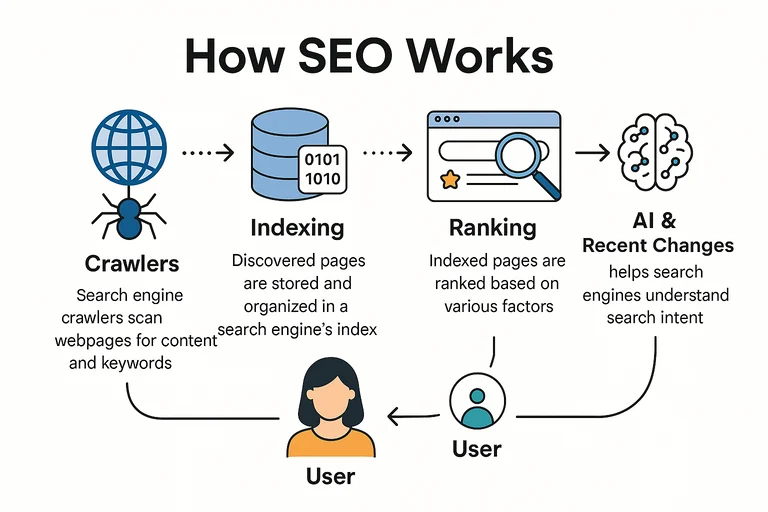
We will understand the workflow of seo in detail by dividing it into four phases.
1. Processing Phase
This phase is about understanding the work done by search engines even before the user query arrives. The engine keeps crawling, indexing, and ranking web pages long before the user types a query.
Along with these three activities, it also does some other preparatory operations, such as:
- Search engines are in a constant state of understanding what users are trying to find. So that they provide the most accurate result by comprehending user intent, even if the user query is imprecise or lacking.
- They are working to give more personalized and practical results based on user search history, location, and other metrics.
- They also prepare for spam prevention to lower the position of spammy websites in their search results. For users to have a good time and quickly find what they are looking for.
2. Query Submission Phase
Now, when the user has searched for something, the search engine searches the index for the most relevant pages to the query. Then it ranks them based on various seo metrics such as content, web authority, location, and search history. And finally, it shows the most compatible and appropriate results.
3. Enhancement Phase
Now, when the user has inquired and got results, and everything is done, the time comes to check what could have been done better. Where does your website need improvement? All this is done by analyzing the user behavior and search engine results pages (SERPs), following a few steps:
- The data is collected using various methods and some tools and platforms such as Google Analytics, Google Search Console, and third parties.
- Then this data is analyzed by SEO professionals to understand trends and patterns. And spot the strengths and weaknesses for room for improvement.
- Now, changes or adjustments required are implemented by seo professionals. These changes can be on-page, off-page, or technical.
- The last step is to keep a track of website performance after making changes and understanding how it is impacting. And finding whether any further improvements are required.
4. Feedback Phase
Feedback is one of the most important parts in the seo, as search engines keep on evolving and require constant changes.
Factors like keyword relevance, user behavior, how they are interacting with the website, content quality, average session time, and page loading speed. The security, like HTTPS connections and information’s relevance and correctness are also taken into consideration.
What is SEO Strategy?
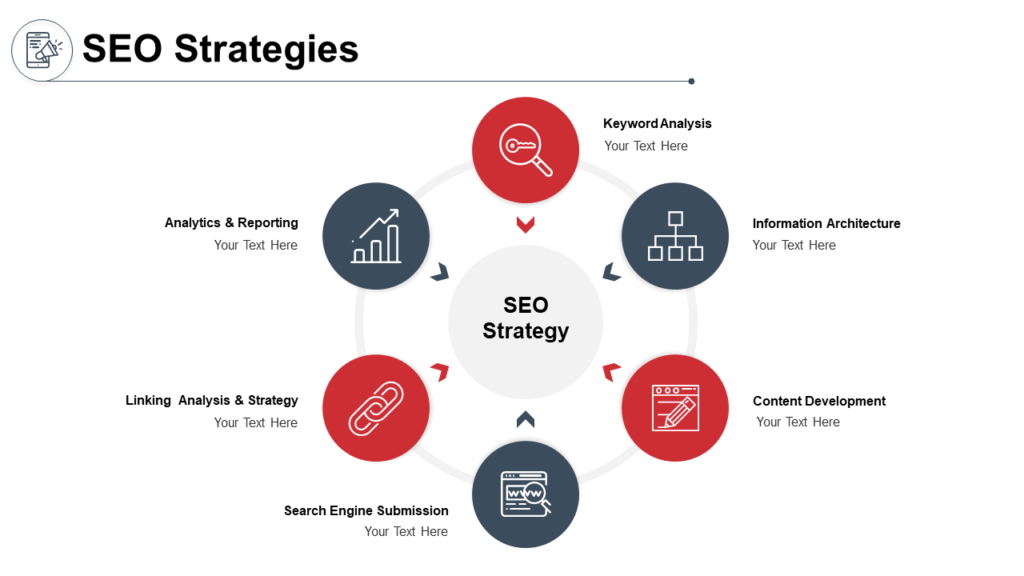
Just like any process in digital marketing, you need a road plan to implement, track, and refine the plan to get the best results. The same goes for SEO; you need a robust plan for it to work efficiently.
SEO strategy is focused on optimizing your website content to get the highest possible rank on search engines, mostly rank number one. The main goal is to increase organic traffic to be found by your target audience.
It helps to stay updated with your content, instead of investing in something that is draining resources and still not performing. Therefore, it helps you to create quality content based on performance and user intent.
Important SEO Metrics To Measure
- Keywords: These are the terms or phrases that people type in the search bar of social media sites. By tracking, you get an understanding of which are the most searched keywords, and also which ones are helping your website rank and gain visibility. It is basically a TOFU (Top of the Funnel) metric.
- Organic traffic: These are visitors on your site who have come through your organic search results. The increase in organic traffic is a sign of positive seo impact. It is a TOFU metric.
- Search Engine Results Page (SERP) results: These rankings show you where your page appears for specific queries. A higher rank shows better visibility, and it is a TOFU metric.
- Dwell time: It shows the amount of time spent on your website by users. If the rate is higher, it indicates that they are finding your content helpful, informative, and valuable. This is an MOFU metric.
- Engagement rate: This metric shows how people are interacting with your website, including likes, shares, time on site, and comments. This is an MOFU (Middle of the Funnel) metric.
- Click-through rate: It shows the number of people clicking through a page or site after seeing a search result. Higher CTR is always better. This is a TOFU metric.
- Brand awareness: It measures recognition and perception of your brand name or its products/services, as it affects brand loyalty and identity. It is a TOFU metric.
- Leads & revenues: Linking leads and revenue to seo helps you determine the effectiveness of your activities and look for performing activities to replicate. This is a BOFU (Bottom of the Funnel) metric.
- Domain authority: It is a sign of where your website stands in search results. Improving domain authority correlates with stronger SEO performance. This is also a TOFU metric.
Importance of SEO
As per stats, organizations see $22 in returns for every $1 invested which a median ROI of 748% delivered by SEO. Also, organic searches account for 53.3% of all website traffic. Search engine optimization is the largest and most sustainable source of website traffic, allowing businesses to get discovered in the market free of cost on every click.
Another key factor is that users prefer trusting the organic results more than the sponsored ones. Also, SEO not just brings traffic but also brings high-intent buyers and potential customers that convert better.
It is helpful in the long run, unlike paid marketing, which stops traffic once the ads go off. The global SEO services market is expected to grow $148.86 billion that is 77% by the year 2030.
Best Tools For SEO
One of the important things you need to keep in mind is that for a compelling and fruitful SEO strategy, you need to use the right tools. Because you are dealing with data, and things only work when you maintain accuracy in data. Only appropriate tools can help you with that. Therefore, I have listed some of the top SEO tools, including both paid and unpaid.
Top 3 Free SEO Tools
Google Search Console
It is widely used and a must-have for any website owner. The primary use of this tool is to monitor performance, but it also leverages AI to a great extent. It helps spot trends, search patterns, figure out anomalies in traffic search, and offer automated recommendations for enhancing the visibility of your site.
It is a great tool for beginners, website owners, and marketers needing an understanding of how Google sees their site.
Some of its features are:
- Keyword & page performance tracking
- Index checking
- Cross-platform checks
- Breakdown or issue alerts and notifications
Screaming Frog SEO Spider
It is a powerful website crawler designed to identify and study on-site SEO issues. It can detect any broken links, duplicate content, or metadata issues. The AI supports streamlined site audits and decision-making.
Best used by SEO professionals, digital marketers, and agencies requiring a comprehensive suite of SEO tools.
Some of the best features:
- JavaScript rendering using AI
- Advanced SEO audits
- Custom data extraction from webpages
- Integration with Google Analytics and Search Console
- Also offers visualization and scheduled crawls
Google Keyword Planner
A free tool in Google Ads that is of great help in keyword research and finding how people search for those words, and what the bidding cost can be.
Individuals or organizations looking for a free keyword research and trend analysis tool can leverage this option.
Offers useful features such as:
- Keyword search volume and forecasting
- CPC estimation
- Narrow down your keyword research by applying filters
- Competitor keyword analysis
Top 3 Paid SEO Tools
Moz Pro
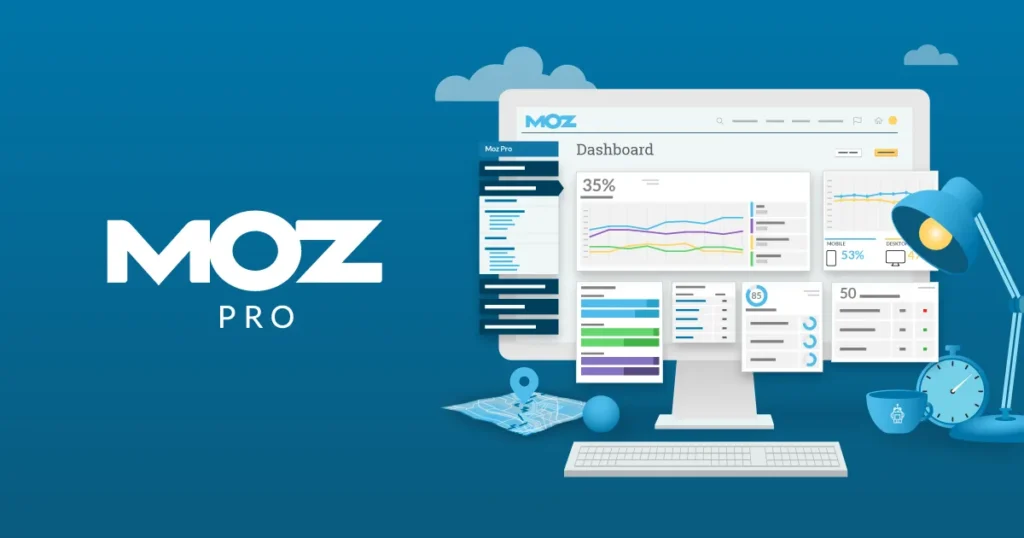
It is an all-in-one SEO platform that businesses can use to view and improve their performance in search engines. As this tool can give smart suggestions and analysis, marketers get greater opportunities to grow and edge over competitors in search engine results.
People looking to invest in an AI-driven platform for advanced SEO strategies and elite online visibility can opt for this tool.
It offers AI assistance to explore keywords and assess potential impact. Site auditing, rank tracking, acquiring quality backlinks, on-page optimization, and competitor analysis are some more useful features.
Price: $99/month (Standard), $179/month (Medium), $299/month (Large). Each plan offers a 30-day free trial to explore features before you stick to the plan.
SEMRush
It is a well-structured, AI-powered marketing platform that helps anyone who needs SEO services. It is a complete suite, flexible and scalable solution offering competition research, content creation, ad optimization, and SMM with local marketing, all of leading with data-backed insights.
Has features such as a comprehensive site audit, backlink analysis, competitor analysis, and more. It also allows you to use your content in the best way possible and offers an AI SEO toolkit.
Pricing: $139.95/month (Pro), $249.95/month (Guru), $499.95/month (Business). Each plan has a 7-day free trial before you commit to the plan.
SE Ranking
SE Ranking is also a complete solution for various SEO tasks, including keyword tracking, auditing your websites, analyzing competitors, and backlink monitoring. You can simply all these processes with the help of this tool.
It can be easily leveraged by professionals, digital marketers, and agencies.
Price: $129/month (Core), $279.00/month (Growth), and some of its Add-On plans with annual billing only include, +$69.00/month (Agency Pack), +$89.00/month (AI-Search), +$149.00/month (API).
AI In SEO
If you are diving deep into search engine optimization and the advancements in it, then you must be aware of search engine intelligence and how it is being widely used in SEO. Therefore, AI is not killing SEO but giving it a new version with more accuracy, time saving, and efficiency.
Relying on the internet for almost everything has become a part of life to an extent that we use the word Googling in our day-to-day lives as if it’s an existing word for ages. There are 354 million searches per hour, which is 3 trillion searches a year.
There is so much data created every day that AI is automatically making its place in seo, as AI relies heavily on data. And it is making the search engine optimization more and more personalized and user intent plus context focused, rather than just holding on to keywords.
Therefore, it has become more about what users mean rather than just what they are saying.
The global AI in search engine market is projected to reach $50.88 billion by 2033 with a CAGR of 13.6% from 2025 to 2033.
Bottom Line
What is seo and how does it work? I hope this writing answered your question in detail. And you learn how SEO is not just about ranking on search engines but offering value to your users. It is a constant adaptation of technology and evolving market needs. We saw how to calculate various seo metrics for a foolproof strategy to scale in the online environment. I have listed the best tools you can use to leverage SEO to the finest level. Artificial intelligence is also upending and improving search engine optimization in real time. So after all, SEO is not just about being seen in the flooded market, but being chosen.
Related: Societal Marketing Concept: Benefits, and Real-Life Examples
Related: Why Faceless Digital Marketing Is the Future of Online Business?


[…] is a link-building agency that provides packages for predictable, month-on-month SEO growth. You need to choose a campaign plan with defined deliverables instead of buying one link at a […]